

The Kill Radius
Anthropic gave Claude a Slack account. The question everyone is asking ("am I a layer or a moat?") is too blunt to act on. Here is the test that predicts who gets eaten, and who gets made stronger.

You can tag @Claude in any Slack thread, starting this past week. It reads the conversation, gets up to speed, and helps move the work forward. It has an ambient mode that monitors channels and chimes in unprompted, so it is proactive, not just reactive.
A few dozen “AI for Slack” startups went on red alert that afternoon. A few dozen “memory for Claude” startups went on red alert the same week, because Claude already ships connectors (400 plus, with custom ones) and a form of memory. That memory is not a knowledge graph. But “a periodically regenerated summary of all your non-deleted chats, optimized for context injection” is not far from one.
Here is what is actually happening.
Anthropic is not eating products. It is eating thin layers
A Slack wrapper is a thin layer. A connector is a thin layer. Memory as a rolling summary is a thin layer. Each of these is something a frontier lab can ship in a Tuesday release.
What a Tuesday release cannot ship is your proprietary data, your domain depth, or your position as the system of record. So the line between what gets absorbed and what survives is predictable. The platform eats what it can reach. It boosts what it cannot.
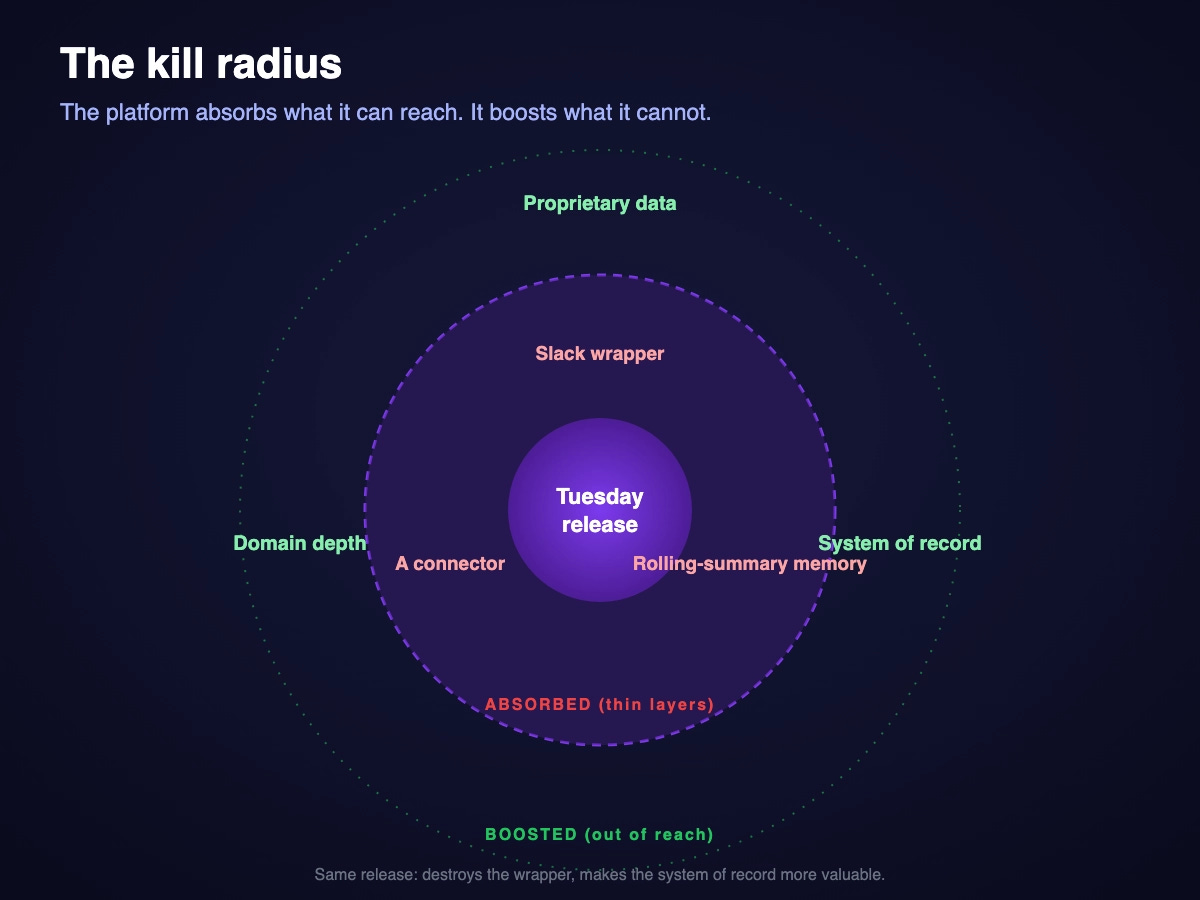
The line is not random. A Tuesday release absorbs the thin layers it can reach and makes everything outside that radius more valuable.
That second half is the part nobody says out loud. If you sit outside the kill radius, Anthropic does not kill you. It makes you the connector everyone has to plug in. The same release that destroys the wrapper makes the system of record more valuable.
“Layer or moat” is the right instinct and the wrong test
The popular framing is binary. If your moat is a feature, the platform absorbs you. If your moat is context the platform cannot reach, the platform makes you stronger. True, but too coarse to act on.
The sharpest version of the critique is unkind. If your entire product is a wrapper around a public model, you are not a moat. You are free R&D for the labs. The next model version absorbs your “special workflow,” and you are back at zero.
a16z published the more useful version in Avoiding Death on the Yellow Brick Road. Joe Schmidt’s thesis: the workflow you ship on day one is not the moat. The loop that production usage creates over time is. “No amount of training compute substitutes for being inside the workflows where this knowledge actually lives.” Foundation models train on public data. They do not sit inside your customer’s process for two years, so they never see the why behind the decisions.
That is the real dividing line in the stack.
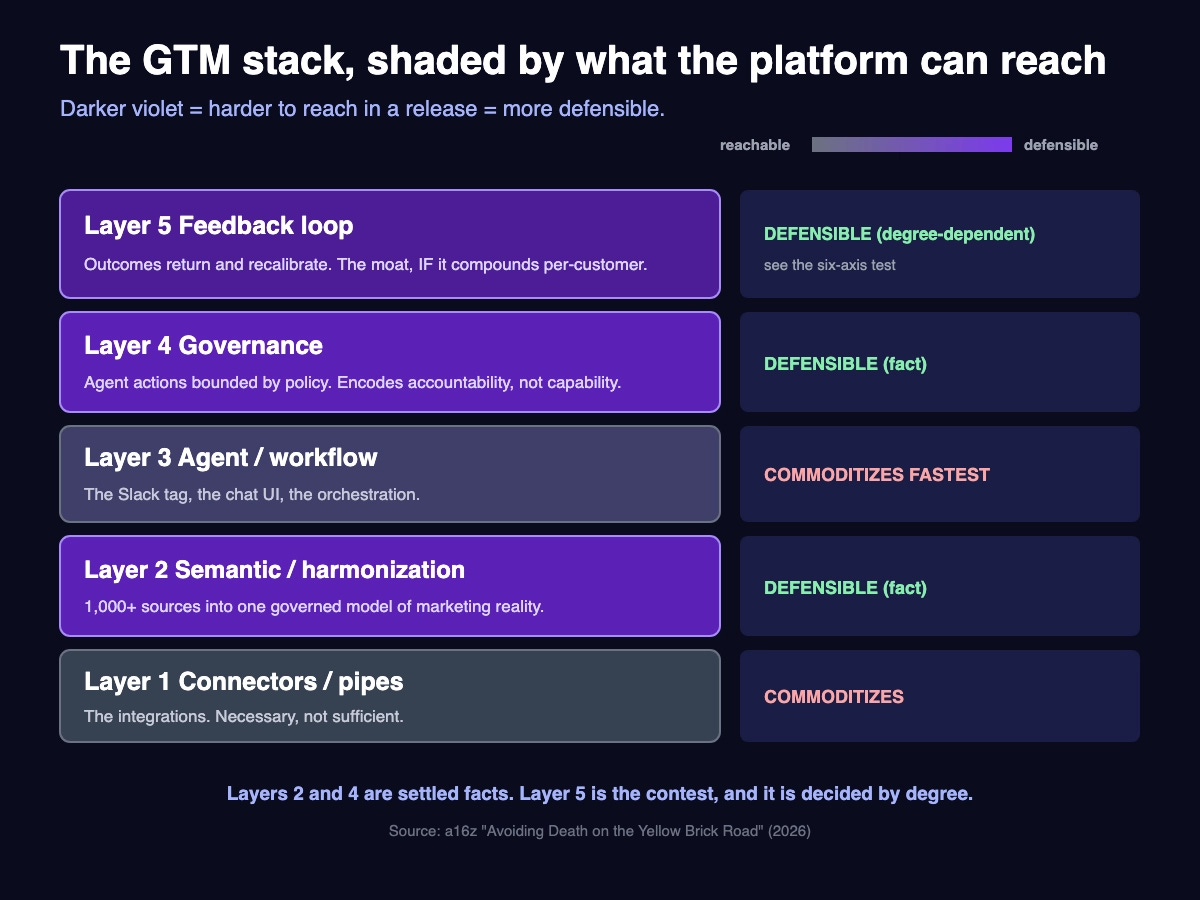
The agent layer commoditizes fastest, because that is exactly the thin layer Anthropic ships on a Tuesday. The semantic and governance layers resist. The feedback loop is the contested layer, and it is decided by degree.
The pipes commoditize. The agent layer commoditizes fastest, because that is exactly the thin layer Anthropic ships on a Tuesday. Two layers resist. The semantic layer, where 1,000 plus sources get harmonized into one governed model of marketing reality, is hard to reach because it took years of integration work to build. The governance layer, where an agent's actions are bounded by policy so it cannot do damage, is hard to reach because it encodes accountability, not just capability. These are not open questions. They are the defensible parts of the stack, and they are defensible because the platform cannot reach them in a release.
A closed loop is not a moat. It is the entry ticket
This is the part most vendors get lazy about. Everyone with an agent says they have a feedback loop. Most do not. They log outcomes globally and call it learning. That is not a flywheel. That is a changelog with good marketing.
The feedback loop closing is a necessary condition. It is not the moat. The moat is the degree of closure. A loop that closes weakly, slowly, or only at the global level is a flywheel spinning too slowly to outrun the commoditization of the layers above it. This is a race. Your loop has to compound faster than Anthropic and generic agents eat the layer beneath you.
So “the loop closes” is table stakes. The honest question is how tightly. I built a framework to stop answering that by feel. Six things you can measure. Higher on each means harder to copy. They are not equal.
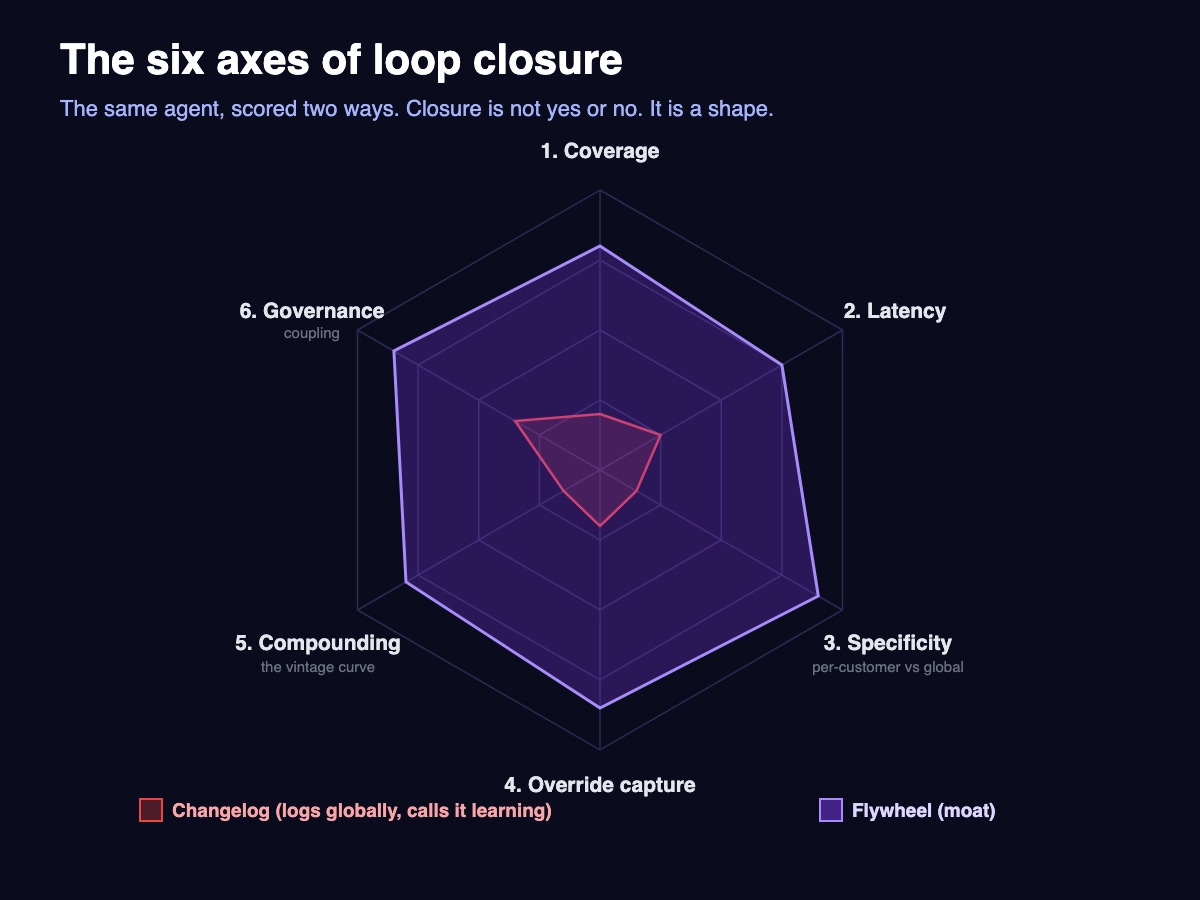
Closure is not yes or no. It is a shape. The changelog logs outcomes globally and calls it learning. The flywheel closes per-customer, fast, and governed.
1. Coverage. Of the decisions the agent actually influenced, what fraction have a measured downstream outcome that returns to the system and updates what it expects next time? Not “we could measure it.” Returned and moved the model. Touch 1,000 decisions, calibrate on 50, your loop is 5 percent closed.
2. Latency. How long from campaign outcome to that outcome becoming an input to calibration? A day, a week, a manual retrain once a quarter, or never automatically? Latency is the spin rate of the flywheel. A slow flywheel gets caught.
3. Specificity: per-customer versus global. This one decides almost everything. If the loop improves a global model, a competitor approximates it from public data and catches up. If the loop improves this specific customer’s agent from this customer’s decision history, it is unreproducible from the outside in principle. This is exactly a16z’s point. That understanding only comes from running the workflow in production thousands of times, and the lab is not inside the process to see it.
4. Override capture. When a marketer overrules the agent (”do not cut that budget, we have a planned conquest campaign”), is the override captured as signal or lost? a16z highlights this as the most valuable signal. Every human correction shows where the runbook was incomplete. In marketing it is the knowledge of which anomalies are expected for this account. A generic agent on a warehouse does not see it structurally.
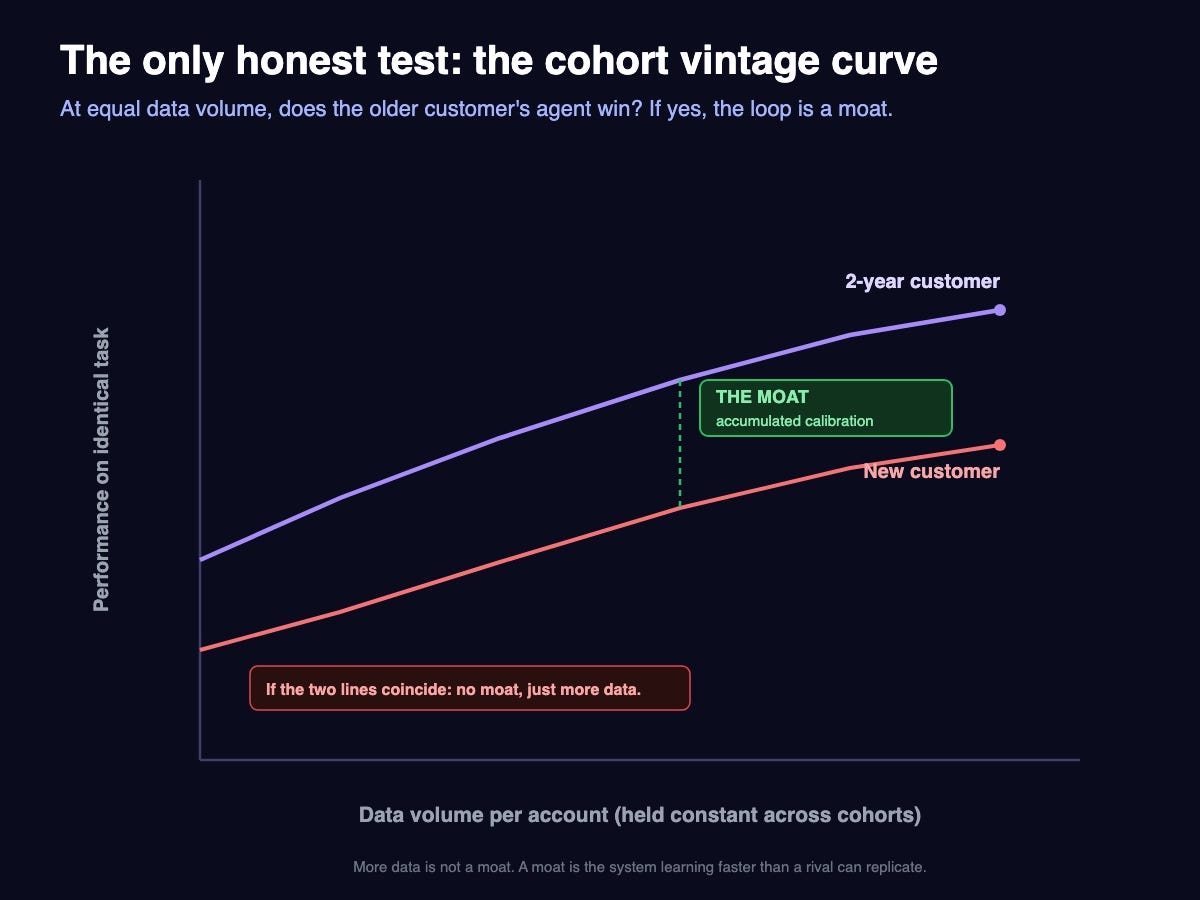
5. Proof of compounding. This is the only honest test. Do older customers, on an identical task, perform measurably better than new ones, controlling for data volume? That is a cohort vintage curve. If a two-year customer’s agent beats a new customer’s agent on the same task, not because it has more data but because it has accumulated calibration, the loop creates a moat. If there is no difference, you do not have a flywheel. You have more data. More data is not a moat.
6. Governance coupling. A loop that closes also closes on bad signal. Picture an agent that fires 50,000 ad-platform API calls in an hour inside a budget reallocation cycle and gets the account suspended for a day. That is a closed loop with no governance. The tighter the closure, the more critical the governance layer. The feedback loop is a moat only when it is coupled to governance. Otherwise it is an error amplifier. Which is convenient, because governance and the loop sell as one story, not two.
Where this leaves Improvado, stated plainly
Two of these are settled. The semantic layer is real and defensible (nine years of integration work turned into one harmonized model of marketing data). The governance layer is real and defensible (an agent bounded by policy, not by hope). And the production feedback loop closes. Production outcomes return into the system. That is a fact, not a pitch.
The degree of closure is the standard we hold ourselves to. We measure it on these six axes. We do not assert it. The vintage curve (axis 5) is more informative than the other five combined, and it is the one we are building from what we already log. That is the difference between a vendor with something to hide and a strategist who defined the measurement.
Here is the honest fork. If axes 3, 4, and 5 hold (per-customer, captures overrides, vintage curve rising), the demotion-to-connector risk inverts. Switching cost stops being “the pipe is annoying to reconnect.” It becomes accumulated, customer-specific calibration that a generic agent on the same warehouse cannot reproduce. It sees the data. It does not see the two-year history of which corrections worked. If instead the closure is mostly global and thin on override capture, we hold on the semantic layer alone. That is a good moat. It is also a finite one, and the demotion-to-connector scenario stays live. That is exactly why we measure rather than claim.
That is the concrete defense against Claude in your Slack. Claude has the memory of the channel. It does not have the two-year history of which budget reallocations worked for the buyer behavior of this specific account. That history is structurally out of reach for a horizontal agent.
So run the test on your own company
Are you a layer, or a moat? Now you have a sharper version. Does your loop close, how fast, and is it per-customer or global? Most “agentic” tools log outcomes globally and call it learning. That is not a flywheel. It is a changelog.
Comment RED if you think Anthropic eventually kills your startup. Comment GREEN if you think it makes you stronger instead. Or just mention any startup you’re thinking about. I will reply with which way I would bet, and why.